
Every month, two numbers move financial markets, influence Federal Reserve decisions, and quietly shape the cost of everything from your grocery bill to your business expenses. Those two numbers are the Consumer Price Index and the Producer Price Index. Yet most people — even business owners and investors — remain confused about the difference between CPI and PPI, what each one actually measures, and why both matter to their financial lives.
This guide breaks it all down in plain English. No economics degree required.
What Is the Difference Between CPI and PPI?
The core difference between CPI and PPI comes down to perspective specifically, whose perspective you are measuring prices from.
CPI measures prices from the consumer’s point of view. It tracks how much everyday people pay for a basket of goods and services things like groceries, rent, gas, healthcare, and clothing.
PPI measures prices from the producer’s point of view. It tracks how much businesses receive when they sell their goods and services — before those products ever reach a store shelf or a consumer’s hands.
Think of it this way: CPI is the price tag you see at the register. PPI is the price the manufacturer charged the retailer before the product even arrived in the store.
The Consumer Price Index (CPI) measures the average change over time in the prices paid by urban consumers for a fixed basket of goods and services representing typical household spending.
The Producer Price Index (PPI) measures the average change over time in the selling prices received by domestic producers for their output covering goods, services, and construction at every stage of production.
What Is CPI? (Consumer Price Index Explained Simply)
The Consumer Price Index is the most widely reported inflation measure in the United States and most major economies. The CPI is calculated by the U.S. Bureau of Labor Statistics (BLS) and released monthly, measuring the change in average prices paid by consumers for a set of goods and services that represent regular expenses, like groceries or gas. Fundingsouq
When you hear a news anchor say “inflation rose 2.4% this year,” they are almost always referring to the CPI. It is the inflation number that affects your rent increases, your Social Security payments, your salary negotiations, and the Federal Reserve’s interest rate decisions.
How Is CPI Calculated?
The BLS surveys thousands of prices every month across hundreds of categories. These prices are then weighted based on how much of a typical household budget each category represents. Housing costs carry the most weight because most families spend the largest share of their income on rent or mortgage payments.
To calculate the index, price changes are averaged with weights representing their importance in the spending of the particular group. The index measures price changes as a percent change from a predetermined reference date. The BLS also releases a seasonally adjusted CPI, which removes the effects of seasonal changes such as weather, school year, production cycles, and holidays. Whop
The current base period for the CPI is the average of prices from 1982 to 1984, which is set equal to 100. If the CPI today reads 315, it means prices have risen 215% since that baseline period.
What Does CPI Measure?
The CPI tracks eight major spending categories that together represent the typical American household’s budget:
Housing — rent, homeowners’ equivalent rent, utilities, and household furnishings. This is the largest component, carrying roughly 44% of the total CPI weight.
Food and Beverages — groceries, restaurant meals, and non-alcoholic drinks. The all-items CPI increased 0.4 percent from December 2025 to January 2026 and was up 2.4 percent from January 2025. Food prices in January 2026 were 2.9 percent higher than in January 2025. Medium
New and used vehicles, gasoline, auto insurance, and public transit.
Prescription drugs, doctor visits, hospital services, and health insurance.
Tuition, textbooks, phone plans, and internet service.
Sporting goods, streaming services, admission fees, and pets.
Clothing, footwear, and accessories.
Personal care, tobacco, and miscellaneous items.
Types of CPI You Should Know
The most commonly reported version, covering approximately 93% of the U.S. population including wage earners, professionals, self-employed workers, retirees, and unemployed individuals.
Covers a narrower group of workers and is used specifically to calculate Social Security cost-of-living adjustments. For 2026, the SSA announced a cost-of-living increase of 2.8%.
Excludes food and energy prices because of their volatility. Core CPI rose 0.3% from December to January 2026 and 2.5% over the past 12 months. The Federal Reserve pays close attention to Core CPI when making interest rate decisions.
What Is PPI? (Producer Price Index Explained Simply)
While CPI gets most of the media attention, the Producer Price Index is arguably more important for understanding where consumer prices are headed next. The Producer Price Index measures transaction prices received by domestic producers of goods and services a distinction that may look subtle but is not. Osome
For businesses, understanding these costs is especially important, and using the best AI tools for small business can help companies analyze data, manage expenses, and make smarter decisions.
Understanding the difference between CPI and PPI requires understanding this supply chain reality: most products pass through multiple hands before reaching a consumer, and the PPI captures price changes at every one of those stages.
How Is PPI Calculated?
Like CPI, the PPI is calculated monthly by the U.S. Bureau of Labor Statistics. The BLS constructs the PPI to cover a much wider array of transactions than the CPI, because producers not only create products that consumers buy called final demand products but also create products purchased by other producers as inputs. The price received by these intermediate producers is called an intermediate demand price. Osome
The BLS collects price data directly from producers through voluntary surveys, covering over 10,000 products and service categories. Prices are collected at the point of first commercial sale meaning the transaction between a producer and the first buyer, whether that is a retailer, a distributor, or another manufacturer.
What Does PPI Measure?
The PPI covers three broad categories of output:
Finished Goods:- products ready for final sale to end users. This includes consumer goods like food and clothing but also capital equipment like machinery that businesses purchase.
Intermediate Goods:- partially processed materials sold to other producers for further processing. Examples include flour sold to a bakery, steel sold to a parts manufacturer, or chemicals sold to a pharmaceutical company.
Crude Materials:- raw materials at the earliest stage of production, including farm products, minerals, and raw fuels that have not yet been processed.
The Producer Price Index for final demand advanced 2.7 percent from September 2024 to September 2025, with prices for final demand goods increasing 3.3 percent while prices for final demand services rose 2.5 percent. The Wanderlover
Stages of Production in PPI
To illustrate how the PPI captures the full production chain, consider the production of a pickup truck. In stage one, producers create steel and sell to other producers who, in stage two, fabricate specialized steel equipment used to produce, in stage three, the parts assembled into a pickup truck. The truck is sold to the final consumer in stage four. Osome
The PPI captures price movements at every one of these stages. This is exactly why the difference between CPI and PPI matters so much to economists and businesses PPI price increases at stage one or two often signal consumer price increases weeks or months later.
CPI vs PPI — Key Differences Explained Side by Side
Now that you understand both indexes individually, let us put the difference between CPI and PPI in direct comparison. Use the table below as a quick reference it covers every major dimension where the two indexes diverge.
| Factor | CPI | PPI |
|---|---|---|
| Full Name | Consumer Price Index | Producer Price Index |
| Measures | Prices paid by consumers | Prices received by producers |
| Perspective | Buyer (end consumer) | Seller (business/manufacturer) |
| Published By | U.S. Bureau of Labor Statistics | U.S. Bureau of Labor Statistics |
| Release Schedule | Monthly | Monthly |
| Includes Imports? | Yes | No (domestic production only) |
| Includes Taxes? | Yes (sales taxes included) | No (pre-tax prices) |
| Includes Profit Margins? | Yes | No |
| Covers Services? | Primarily consumer services | All service industries |
| Leading/Lagging | Lagging indicator | Leading indicator |
| Used For | COLA adjustments, Fed policy | Inflation forecasting, contracts |
| Base Period | 1982–1984 = 100 | 1982 = 100 |
Who Pays the Price — Consumer vs Producer
The most fundamental difference between CPI and PPI is who is doing the paying. CPI tracks what consumers hand over at the point of purchase the final price that includes production costs, shipping, retail markup, taxes, and profit margins stacked on top of each other.
PPI strips all of that away. It measures only what the producer received when they sold their output before it moved further along the supply chain. This means PPI prices are typically lower than CPI prices for the same product category, because the retailer’s markup and taxes have not yet been added.
What Gets Measured
CPI is deliberately limited to goods and services that typical urban households buy for personal consumption. It deliberately excludes business purchases, investments, and government spending.
PPI is far broader. The CPI and PPI are equally comprehensive both measure prices paid and received in domestic transactions but the big difference is the much larger universe of producer transactions that PPI captures. Osome PPI covers industries that consumers never interact with directly: mining, agriculture, manufacturing, wholesale trade, and intermediate services.
How Each Index Is Used
CPI is primarily used for cost-of-living adjustments in government programs and private contracts, Federal Reserve monetary policy decisions, inflation-adjusted financial calculations, and tax bracket adjustments. PPI is primarily used for inflation forecasting and early warning signals, escalation clauses in long-term business contracts, measuring producer profit margins, and analyzing supply chain cost pressures before they reach consumers.
Why Does the Difference Between CPI and PPI Matter?
Understanding the difference between CPI and PPI is not an academic exercise. It has direct, practical consequences for investors, business owners, policymakers, and everyday consumers.
The difference between CPI and PPI tells a story about where prices are in the economic cycle specifically, whether inflation is building at the production level before it reaches consumers, or whether it is already embedded in what households are paying.
CPI and PPI as Leading and Lagging Indicators
This is where the difference between CPI and PPI becomes most strategically valuable. PPI is considered a leading indicator of inflation it tends to move before CPI does. CPI is a lagging indicator it reflects price changes that have already worked their way through the supply chain.
Here is why: when producers face higher costs for raw materials or intermediate inputs, they typically absorb those costs for a period before passing them on to retailers. Retailers then absorb costs for a period before passing them on to consumers. This pipeline means PPI increases often show up in CPI data weeks to months later.
When PPI is rising significantly faster than CPI, it is an early warning that consumer prices are likely to rise in the coming months. Investors, central banks, and business planners use this relationship between the difference between CPI and PPI as a forward-looking signal.
How CPI and PPI Affect Federal Reserve Decisions
The Federal Reserve targets a 2% annual inflation rate because it encourages businesses and consumers to continue spending, saving, borrowing, and investing. When prices rise sharply, it can mean the economy is overheated, with too much demand or too little supply. Fundingsouq
The Fed watches both indexes closely. When CPI rises above 2%, the Fed typically raises interest rates to cool consumer spending. When PPI rises significantly above CPI, the Fed reads this as a signal that consumer inflation is likely incoming and may raise rates preemptively.
Both the CPI and PPI help a wide spectrum of economic and policy actors better understand the economic world around them. The ability to discern the direction and pace of price change promotes better public and private decision-making, making the economy more efficient. Osome
How CPI and PPI Affect Your Wallet
For everyday consumers, the CPI has the most direct impact. It determines how much your Social Security check increases, how your landlord justifies a rent hike, and whether your salary is keeping pace with the cost of living.
For business owners, PPI matters more on a day-to-day basis. If the PPI for your input materials steel, packaging, chemicals, food ingredients is rising, you can expect your supplier invoices to increase before your customers ever feel the impact. The difference between CPI and PPI gives you advance notice to adjust pricing, renegotiate contracts, or find alternative suppliers before your margins get squeezed.
CPI and PPI in 2026 — Current Data and What It Means
Understanding the difference between CPI and PPI is most useful when applied to real current data. Here is where both indexes stand as of early 2026.
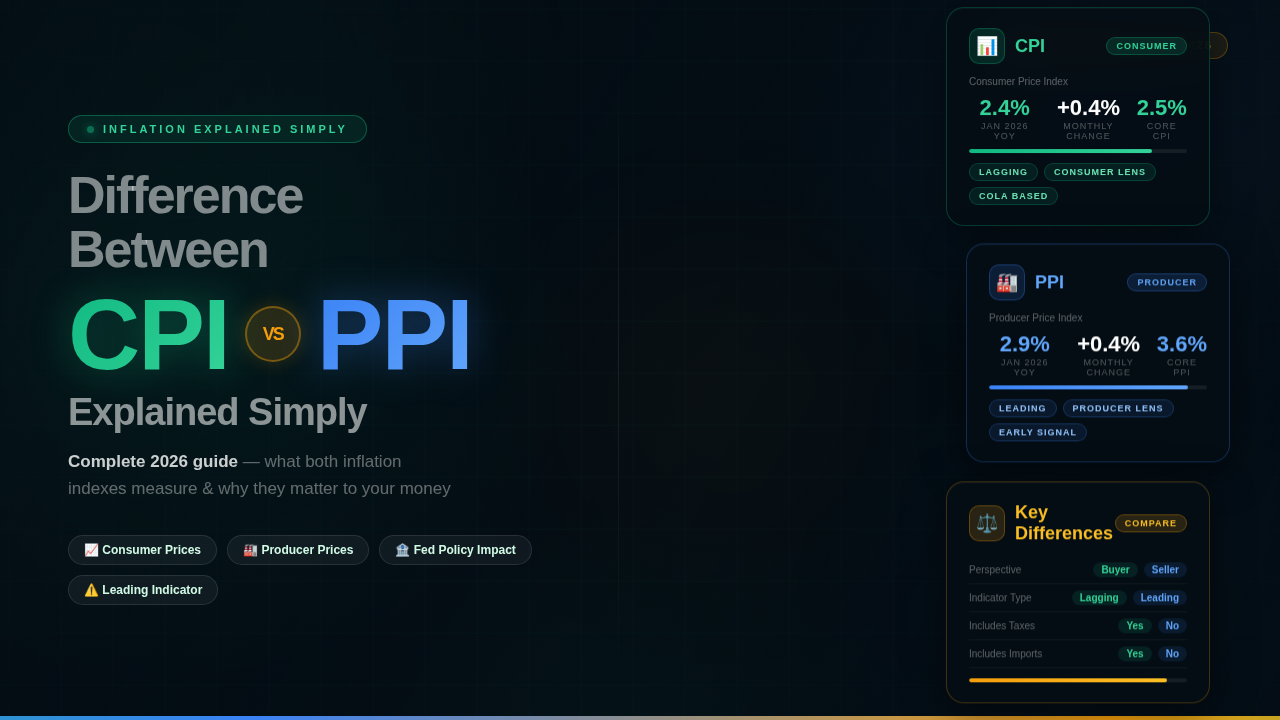
Current CPI Data: The all-items CPI increased 0.4 percent from December 2025 to January 2026 and was up 2.4 percent from January 2025. Shelter, which includes rent, increased at a rate of 0.2 percent in January and is up 3 percent since January 2025. Medium
Current PPI Data: The Producer Price Index for final demand rose 2.9 percent for the 12 months ended January 2026. The January increase was led by a 0.8 percent advance in the index for final demand services, while final demand goods moved down 0.3 percent, largely due to a 5.5 percent drop in gasoline. Medium
What This Means in Plain English: PPI at 2.9% is running ahead of headline CPI at 2.4% meaning producers are experiencing slightly more price pressure than consumers are currently feeling. Core producer prices jumped 0.8 percent in the most recent month, the most in six months, and rose 3.6 percent year-on-year — well above forecasts. Shopify This gap between core PPI and CPI suggests some additional consumer price pressure may work its way through the pipeline in the coming months.
This is the difference between CPI and PPI in real-time action PPI giving early signals that CPI data may follow.
Common Mistakes People Make When Comparing CPI and PPI
Many people who learn about the difference between CPI and PPI for the first time make the same errors in interpreting the data. Here are the most common one and how to avoid them.
They are related but not tightly synchronized. PPI can rise for months without CPI following, especially if businesses absorb costs rather than passing them on, or if other parts of the supply chain offset the increase.
This is often true for consumer goods, but not always. In categories where retail competition is fierce, markups may be thin, and CPI can actually sit close to or even below PPI for certain products.
Business owners negotiating long-term supply contracts should use relevant PPI indexes — not CPI — for escalation clauses. Using CPI in a manufacturing contract will not accurately reflect the actual input cost pressures your business or supplier faces.
Headline CPI and headline PPI include volatile food and energy prices that can swing dramatically month to month. Core CPI and Core PPI — which exclude these categories — give a cleaner picture of underlying inflation trends and are what the Federal Reserve watches most closely.
Both CPI and PPI are survey-based estimates with known limitations. CPI in particular is criticized for underweighting housing costs and for a substitution bias — it doesn’t fully account for consumers switching to cheaper alternatives when prices rise.
CPI vs PPI vs PCE — What Is the Difference?
When researching the difference between CPI and PPI, you will inevitably encounter a third inflation measure: the Personal Consumption Expenditures price index, or PCE.
The CPI and the PPI are released each month by the U.S. Bureau of Labor Statistics, while the PCE is released by the Bureau of Economic Analysis. Fundingsouq
Here is how all three compare:
Measures what urban consumers actually pay, based on a fixed basket of goods. It is the most publicly reported and the most directly relevant to household budgets.
Measures what domestic producers receive. It is the broadest coverage of business-to-business transactions and the strongest leading indicator of future consumer inflation.
Measures prices across all personal consumption, including purchases made on behalf of consumers by employers and government (like employer-provided healthcare). The Federal Reserve officially targets PCE rather than CPI for its 2% inflation goal, because PCE accounts for substitution behavior more accurately.
Frequently Asked Questions
Q:- Is CPI higher or lower than PPI?
Neither is consistently higher or lower than the other in absolute terms they measure different things at different points in the supply chain. However, CPI prices for consumer goods are typically higher than the PPI prices for the same category of products, because CPI includes retail markups, distribution costs, and sales taxes that PPI does not. The more useful comparison is the rate of change — when PPI growth is outpacing CPI growth, it signals that producer cost pressures may push consumer prices higher in the near future.
Q:- Does PPI predict CPI?
Yes this is one of the most practically valuable aspects of the difference between CPI and PPI. PPI is widely used as a leading indicator of CPI because price increases at the production level tend to pass through to consumers after a lag of weeks to several months. Economists and analysts monitor the gap between PPI and CPI growth rates specifically for this predictive signal. When PPI rises significantly faster than CPI for consecutive months, it generally forecasts upward pressure on consumer prices ahead.
Q:- Which is more important — CPI or PPI?
It depends entirely on who is asking. For everyday consumers and households, CPI is more directly relevant because it measures the prices they actually pay and determines cost-of-living adjustments to wages, benefits, and government programs. For business owners, investors, and supply chain managers, PPI is often more important because it provides earlier signals of cost changes and reflects the price environment businesses operate in. For monetary policymakers, both matter but the Federal Reserve actually targets PCE as its primary inflation measure.
Q:- Who publishes CPI and PPI?
Both the CPI and the PPI are released each month by the U.S. Bureau of Labor Statistics (BLS). Fundingsouq The BLS is an independent statistical agency within the U.S. Department of Labor. PPI data for January 2026 was released by the BLS, with February 2026 PPI data scheduled for release on March 18, 2026. Medium Both reports are released at 8:30 AM Eastern Time on their scheduled release dates and are available free of charge at bls.gov.
Q:- What happens when PPI rises faster than CPI?
When PPI rises significantly faster than CPI, it indicates that producers are absorbing costs their input prices are rising faster than the prices they can charge consumers. This squeezes profit margins across industries. Eventually, producers are forced to pass these costs on, which causes CPI to rise.
Core producer prices rose 3.6 percent year-on-year in early 2026, well above forecasts and above the CPI rate a signal that producers are under cost pressure that could translate into higher consumer prices in the months ahead. Shopify When this gap persists, it is also a signal the Federal Reserve watches closely when deciding whether to adjust interest rates.
Final Summary — CPI and PPI Difference in Plain English
Let us bring the entire difference between CPI and PPI back to its simplest form.
CPI is the consumer’s number. It tells you how much more expensive your life is getting. It moves after prices have already worked through the supply chain and arrived at the store shelf. It is the index that directly affects your paycheck adjustments, rent increases, and Social Security payments.
PPI is the producer’s number. It tells you how much more expensive it is getting to make things. It moves before consumers feel the impact, giving a valuable early warning signal that the difference between CPI and PPI translates into real predictive power for investors and business owners.
Together, the difference between CPI and PPI tells the complete story of inflation from the moment raw materials enter a factory to the moment a finished product is placed in a consumer’s shopping cart. Neither index alone is sufficient. Both together give you the full picture.
The next time you see a monthly inflation report, do not stop at the headline CPI number. Pull up the PPI release as well. The gap between them and the direction each is moving will tell you far more about where the economy is headed than either number in isolation.