
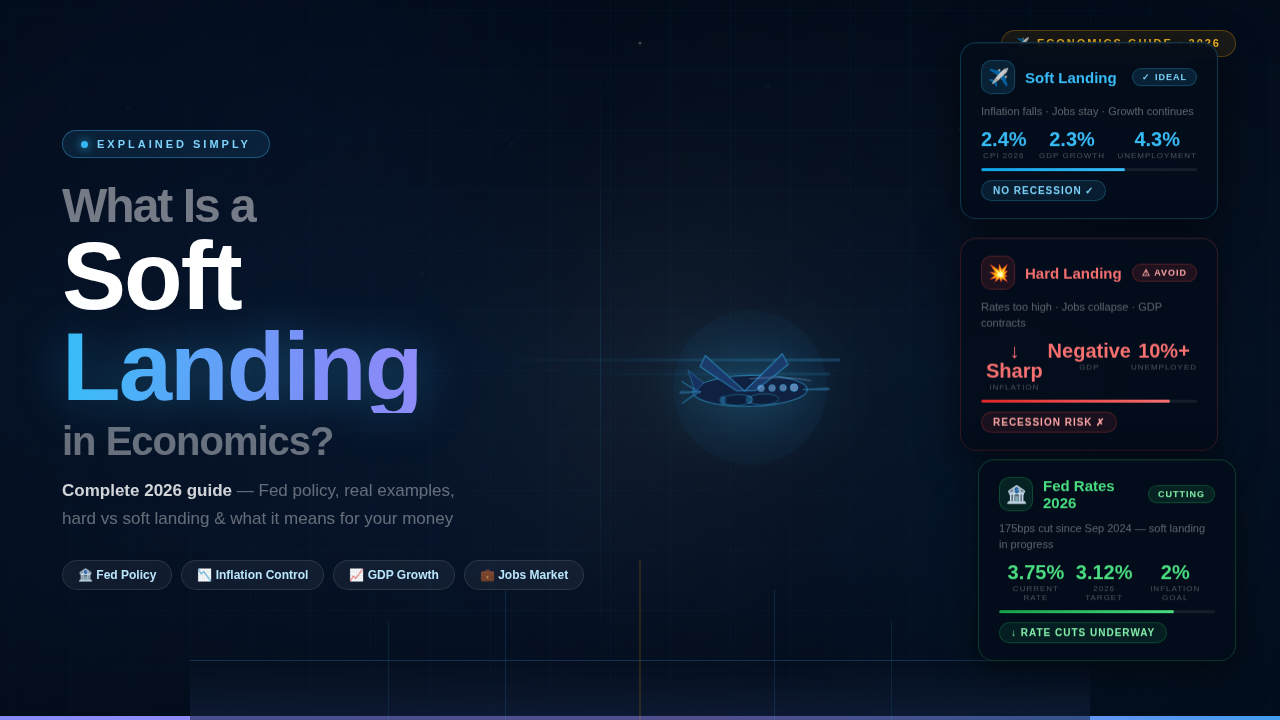
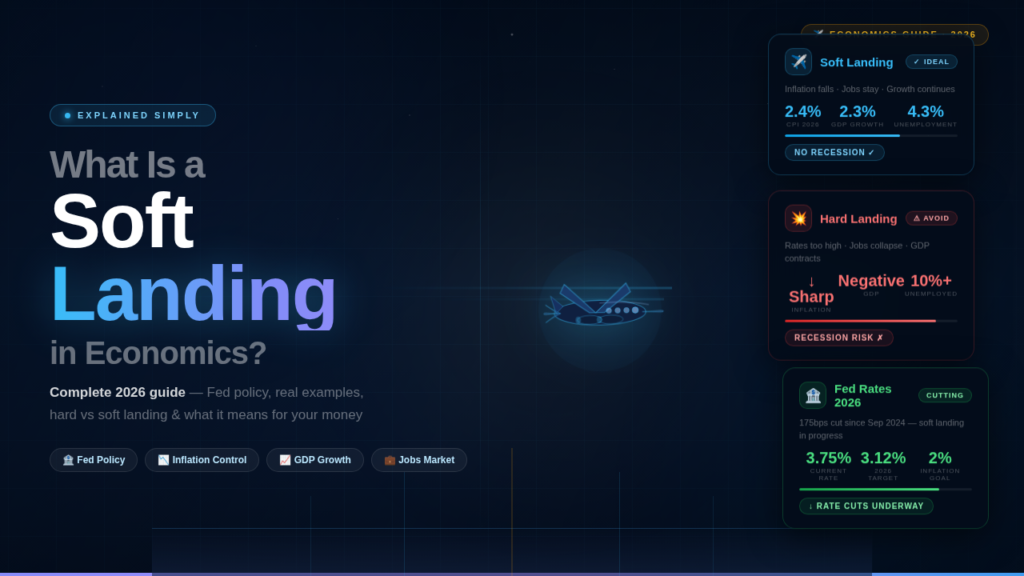
Every time inflation rises and the Federal Reserve raises interest rates, the same question ripples through financial markets, newsrooms, and kitchen table conversations: will this end in a recession, or can the Fed pull off a soft landing? For most people, the term sounds reassuring but vague. What does it actually mean? And why does it matter so much to investors, homebuyers, business owners, and everyday workers?
This guide answers every question about what is a soft landing in economics from the basic definition to real historical examples, current 2026 data, and exactly what it means for your money right now.
What Is a Soft Landing in Economics? (Simple Definition)
What is a soft landing in economics? At its core, it is exactly what it sounds like a controlled, gentle slowdown of the economy that avoids a crash.
More precisely: a soft landing occurs when a central bank most commonly the U.S. Federal Reserve successfully raises interest rates to slow inflation without triggering a recession. The economy cools just enough to bring prices under control, but not so much that growth collapses, unemployment surges, or businesses start mass layoffs.
A soft landing happens when the Federal Reserve successfully slows inflation without triggering a recession growth cools just enough to relieve price pressures but stays positive. It is the perfect balancing act: cooling demand while preserving jobs and earnings. Medium
In other words, what is a soft landing in economics is the question of whether a central bank can be a surgeon precise enough to reduce fever without stopping the patient’s heart. It is one of the most difficult feats in all of macroeconomic policy — and one of the rarest.
The Aviation Analogy That Makes It Click
The term “soft landing” is borrowed directly from aviation. When a pilot brings a plane in to land, there are two outcomes. A soft landing is smooth, controlled, and barely felt by passengers. A hard landing is jarring, potentially damaging, and in extreme cases dangerous.
Applied to economics: the economy is the plane, inflation is the altitude that got too high, and the Federal Reserve is the pilot using interest rates as the throttle. Raise rates too slowly and inflation stays dangerously high. Raise rates too aggressively and you stall the engine crashing into recession. The soft landing in economics is the outcome where the pilot threads the needle perfectly.
The Official Definition Is There One?
There is no official definition of a soft landing. The National Bureau of Economic Research, often considered the quasi-official arbiter of dating recessions, does not define hard or soft landings. Princeton economist Alan Blinder, a former Fed vice chair, says that if GDP declines by less than 1%, or the NBER doesn’t declare a recession after at least a year of a Fed rate-hiking cycle, he considers that a soft landing. Shopify
Many economists consider a mild recession with only a small rise in unemployment to be “softish” close enough to count. The lack of a precise definition is part of why debates about whether the Fed has achieved a soft landing in economics are almost always contested long after the fact.
Soft Landing vs Hard Landing vs No Landing Key Differences
To fully understand what is a soft landing in economics, you need to understand what it is being compared against. There are three possible outcomes every time the Federal Reserve tightens monetary policy.
What Is a Hard Landing in Economics?
A hard landing is the worst-case outcome of a rate-hiking cycle. It occurs when the Federal Reserve raises interest rates too aggressively, or holds them too high for too long, causing the economy to contract sharply. If the Fed raises interest rates too much, it may cause a recession known as a hard landing. Shopify
Hard landings are characterized by rising unemployment, falling consumer spending, declining corporate profits, and often a credit crunch as lending standards tighten. The recession of 1980 to 1982 triggered by the Fed’s aggressive rate hikes under Paul Volcker to crush double-digit inflation is the textbook example of a hard landing. Inflation was defeated, but at the cost of unemployment reaching 10.8%.
What Is a No Landing Scenario?
A no landing scenario is a newer concept that emerged during the post-pandemic economic cycle. It describes a situation where the economy continues growing at a strong pace even while the Fed is raising interest rates meaning monetary policy is not slowing the economy at all. While this sounds positive on the surface, a no landing outcome is actually concerning because it means inflation may prove much more difficult to bring down, potentially forcing the Fed to raise rates even higher and longer eventually resulting in a harder crash later.
Side-by-Side Comparison Table
| Scenario | Inflation | GDP Growth | Unemployment | Recession? |
|---|---|---|---|---|
| Soft Landing | Falls to target | Slows but stays positive | Rises slightly or stable | No |
| Hard Landing | Falls sharply | Contracts | Rises significantly | Yes |
| No Landing | Stays elevated | Remains strong | Stays low | No — but risk builds |
| Stagflation | Stays high | Stagnates or falls | Rises | Possible |
How Does the Federal Reserve Try to Achieve a Soft Landing?
Understanding the mechanics of what is a soft landing in economics requires understanding what levers the Federal Reserve actually pulls and why those levers are so difficult to calibrate precisely.
The Fed’s Dual Mandate Explained
The Federal Reserve operates under a dual mandate from Congress: maintain price stability and maximize employment. These two goals are naturally in tension during inflationary periods. Raising rates to bring down inflation risks raising unemployment. Cutting rates to protect employment risks reigniting inflation.
The Federal Reserve’s rationale for its rate-cutting cycle was that the central bank intends to focus on maintaining full employment and creating the conditions to support the soft landing of the economy that past years of difficult policy decisions have obtained. Osome Navigating between these two objectives without sacrificing either is the core challenge of achieving a soft landing in economics.
Interest Rates — The Fed’s Primary Tool
The Federal Reserve’s main instrument is the federal funds rate the interest rate at which banks lend to each other overnight. When this rate rises, borrowing becomes more expensive throughout the entire economy. Mortgages, auto loans, business credit lines, and credit card rates all rise in response. This reduces spending and investment, which cools demand, which if everything goes to plan brings inflation down.
After raising rates 11 times between March 2022 and July 2023 the fastest tightening cycle since 1982 the federal funds rate reached 5.25% to 5.50%, its highest level since 2001. Medium The question of whether that cycle achieved a soft landing in economics or planted the seeds of a harder slowdown defined much of the economic debate through 2025 and into 2026.
Why Timing Makes Soft Landings So Difficult
The Federal Reserve faces a fundamental timing problem. Interest rate changes do not affect the economy instantly they work with what economists call “long and variable lags.” It can take 12 to 18 months for a rate hike to fully flow through to consumer spending, business investment, and employment data.
This means the Fed is always steering the plane using instruments that show where the plane was not where it is right now. By the time the data confirms that inflation is falling, the rate hikes may have already done more damage to employment than intended. This delay is the primary reason that engineering a soft landing economics outcome requires not just the right policy decisions but nearly perfect timing.
Real Historical Examples of Soft Landings
Studying actual historical examples is the best way to make what is a soft landing in economics concrete and understandable. History gives us a few genuine successes and far more near-misses.
1994 to 1995 The “Perfect” Soft Landing
The most celebrated example of a successful soft landing in economics occurred under Federal Reserve Chairman Alan Greenspan in 1994 and 1995. By February 1994, the unemployment rate was falling rapidly, down from 7.8% to 6.6%. CPI inflation sat at 2.8%, and the federal funds rate sat at around 3%.
With the economy growing and unemployment shrinking rapidly, the Fed was concerned about a potential pick-up of inflation and decided to raise rates preemptively. During 1994, the Fed raised rates seven times, doubling the federal funds rate from 3% to 6%. Shopify
The results were nothing short of spectacular. Alan Blinder, former vice chairman of the Federal Reserve, noted that this was the “perfect soft landing that helped make Alan Greenspan a central banking legend.” Economic performance for the remainder of the decade was strong: inflation was low and steady, unemployment continued to trend downwards, and real GDP growth averaged above 3% per year. Shopify
What made this soft landing economics success possible was that the Fed acted preemptively raising rates before inflation became entrenched, rather than after. This gave it more room to cut rates when the economy began to soften.
1984 — A Successful But Overlooked Landing
Examining 11 periods of Fed rate increases from 1965 to 2019, Blinder counts five soft or softish landings. Shopify The 1984 episode is among the least discussed but most instructive. Coming off the deep recession of 1982, the economy roared back with GDP growth exceeding 7% in 1983 raising serious inflation concerns.
The Fed tightened policy, successfully slowing growth to a sustainable pace without triggering another recession. Unemployment continued falling and inflation stayed contained a clean example of what is a soft landing in economics working as intended.
2022 to 2024 — Did the Fed Achieve a Soft Landing?
The most recent and most debated case is the Fed’s response to post-pandemic inflation. Following an easing of the lockdowns during the COVID-19 pandemic in 2020, disruptions to supply chains and substantial fiscal and monetary stimulus caused inflation to rise to a 10% annual pace in the first quarter of 2021. The Fed responded, belatedly, raising interest rates sharply by more than 5 percentage points beginning in March 2022. Shopify
Despite widespread predictions of recession, the U.S. economy avoided contraction. As inflation moderated and growth remained strong through 2024, the probability of a soft landing reversed from below 5% in late 2022 to a dominant scenario by 2024. Mintos Whether this constitutes a confirmed soft landing in economics or a delayed hard landing remains one of the most actively debated questions in macroeconomics heading into 2026.
Signs That a Soft Landing Is Happening
Knowing what is a soft landing in economics in theory is one thing. Recognizing the signs of one playing out in real time is another. Here are the three clearest indicators.
Inflation Coming Down Without Mass Unemployment
The defining characteristic of a soft landing economics outcome is that inflation falls toward the central bank’s target typically 2% for the Fed — while unemployment remains relatively stable. When you see monthly CPI and core PCE readings trending lower while the unemployment rate stays below 5%, that is the strongest signal that a soft landing is underway.
GDP Growth Slowing But Staying Positive
In a soft landing, GDP growth decelerates but does not go negative. You typically see annual growth slow from above-trend levels say 3% or higher — down to around 1.5% to 2%. This is sometimes called “below-trend growth,” and it is exactly what the Fed aims for: enough slowing to reduce inflationary pressure, but not enough to tip the economy into contraction.
The Fed’s December 2025 projections show GDP growth of approximately 2.3% for 2026, with the unemployment rate expected to remain around 4.3% and inflation continuing to moderate toward the 2% target. Medium These projections describe a textbook soft landing in economics scenario if they hold.
Interest Rates Beginning to Fall
A third visible signal is when the Federal Reserve begins cutting interest rates — signaling that it believes inflation is sufficiently under control and that the priority has shifted back to supporting growth and employment. At its final meeting of 2025, the Federal Reserve cut interest rates by 25 basis points to a range of 3.50% to 3.75%, having now cut rates by 175 basis points since September 2024. Hostinger Rate cuts after a hiking cycle are among the most reliable signals that policymakers believe a soft landing economics outcome is within reach.
What a Soft Landing in Economics Means for Your Money
Understanding what is a soft landing in economics abstractly is useful. Understanding what it means for your specific financial decisions is what actually matters.
What It Means for Stock Market Investors
A soft landing reinforces a “risk-on but selective” environment: investors can stay invested but should prioritize quality and valuation discipline. Returns in 2026 may look more normalized mid-single-digit equity gains and modest fixed-income yields after several volatile years. Medium
In a soft landing economics environment, cyclical sectors industrials, technology, consumer discretionary, and financials tend to perform well because growth continues even as inflation falls. Defensive sectors like utilities and consumer staples, which typically outperform in recessions, become less attractive relative to growth-oriented investments.
What It Means for Bond Investors
Bonds typically perform well in the later stages of a soft landing in economics cycle. As the Fed cuts interest rates in response to falling inflation, existing bonds with higher yields become more valuable. Duration the sensitivity of a bond’s price to interest rate changes becomes an asset rather than a risk.
Given the expected path of Fed policy, there are opportunities for investors in the belly of the yield curve, managing interest rate risk with bond laddering and seeking higher income outside of core bonds. Hostinger
What It Means for Homebuyers and Mortgage Rates
For prospective homebuyers, a soft landing economics outcome is broadly positive though the timeline for relief is longer than most buyers hope. Rate cuts would ultimately bring the federal funds rate closer to 3% and hopefully reduce 30-year mortgage rates to around 5% from an average of 6.35%. Whop A sustained soft landing environment where the Fed cuts rates gradually over 18 to 24 months would bring mortgage rates down progressively, improving affordability without the demand shock of a recession simultaneously collapsing home prices.
What It Means for Everyday Consumers
For households, a soft landing in economics means inflation at the grocery store, gas station, and utility bill moderates gradually while jobs remain available and wages hold steady. It is not a dramatic improvement felt overnight. But it is a meaningful stabilization after years of price pressure. The Core PCE inflation forecast was projected at 2.5% for 2026 and 2.1% for 2027 MilesWeb, suggesting the price relief most consumers want is real it just arrives over months, not weeks.
The Soft Landing Outlook for 2026
Applying the concept of what is a soft landing in economics to current conditions gives a clearer picture of where the U.S. economy stands right now.
Current Economic Data in 2026
The economic picture entering 2026 is genuinely mixed which is actually typical of a soft landing in progress. The Fed’s December 2025 projections show GDP growth of approximately 2.3% for 2026, with the unemployment rate expected to remain around 4.3% and inflation continuing to moderate toward the 2% target. Medium
As of December 2025, inflation rates still remain above the Fed’s 2% target, and Fed policy in 2026 will depend on economic data, particularly on inflation and the labor market. Hostinger The median FOMC member expects one additional rate cut in 2026, followed by one more in 2027, ending at 3.125%. MilesWeb
This gradual, data-dependent approach is the hallmark of a central bank trying to maintain a soft landing in economics rather than overreacting in either direction.
Risks That Could Derail the Soft Landing
By mid-2025, renewed tariff concerns drove stagflation risk back up and the probability of a soft landing lower — highlighting the potential value of distributional forecasting for policymakers and market participants navigating uncertain macroeconomic conditions. Mintos
Several risks remain that could prevent the soft landing economics scenario from fully materializing. Tariff-driven inflation could re-accelerate price pressures just as the Fed is trying to bring them down creating a stagflationary environment where both growth and prices move in the wrong direction simultaneously.
A new Federal Reserve Chair will likely be selected as Jerome Powell’s term expires on May 15, 2026 Hostinger, introducing potential uncertainty about the future direction of monetary policy at a critical moment. Additionally, the Fed’s December 2025 meeting saw unusual division, with dissents on both sides of the rate decision a reminder that even policymakers are uncertain about the path forward. Medium
Common Misconceptions About Soft Landings
Several widespread misunderstandings about what is a soft landing in economics lead people to misread economic news and make poor financial decisions. Here are the most important ones to correct.
| Misconception | Reality |
|---|---|
| A soft landing means no pain at all | A soft landing still involves slowing growth, rising unemployment to some degree, and tighter credit conditions. It is not painless — it is just significantly less painful than a recession. Some industries and workers will feel the slowdown meaningfully even in a successful soft landing. |
| The Fed announces when a soft landing has been achieved | There is no official declaration. The 🔑 soft landing in economics is a verdict that economists and historians apply retroactively — often months or years after the fact, once it is clear that a recession did not occur. |
| Soft landings are common | They are not. Examining 11 periods of Fed rate increases from 1965 to 2019, Blinder counts only five soft or softish landings. Shopify The base rate of success is less than 50%. This is why markets treat every rate-hiking cycle with genuine concern rather than assuming the Fed will navigate it successfully. |
| A soft landing is permanent | A successful 🔑 soft landing economics outcome simply means a recession was avoided in that cycle. It does not immunize the economy against future downturns. The conditions that caused inflation — supply shocks, excessive stimulus, geopolitical disruptions — can return and force the Fed to tighten again. |
Frequently Asked Questions About Soft Landings
Has the Fed ever achieved a soft landing?
Yes Alan Blinder counts five soft or softish landings across 11 Fed rate-hiking cycles from 1965 to 2019. Shopify The most celebrated is the 1994 to 1995 cycle under Alan Greenspan, widely considered the closest thing to a perfect soft landing in economics in modern history. Whether the post-pandemic tightening cycle of 2022 to 2024 constitutes a sixth successful soft landing is still actively debated among economists.
Is a soft landing good or bad?
A soft landing in economics is unambiguously the best outcome of an inflation-fighting rate cycle. The alternatives hard landing (recession) or persistent inflation are both significantly worse for workers, businesses, and investors. The only scenario better than a soft landing is never needing one in the first place, which means inflation never getting dangerously elevated to begin with.
What is the difference between a soft landing and a recession?
The defining difference is whether GDP growth turns negative for two or more consecutive quarters the traditional definition of a recession. In a soft landing economics scenario, GDP growth slows but remains positive throughout the rate-hiking cycle. In a hard landing or recession, GDP contracts, unemployment rises sharply, and economic output falls. The Fed’s entire goal when raising rates is to achieve the former while avoiding the latter.
How long does a soft landing take?
A complete soft landing in economics cycle from the first rate hike to the point where inflation is back at target and rates begin falling typically takes two to four years. The 1994 soft landing was relatively fast, completing within about 18 months.
The post-pandemic cycle took considerably longer due to the unusual nature of pandemic-era supply disruptions. For everyday consumers, the practical improvement — lower prices, lower mortgage rates, easier credit begins to be felt about 12 to 24 months after the Fed starts cutting rates.
What happens to the stock market during a soft landing?
Stock markets generally perform well in confirmed soft landing in economics environments, though with more moderate returns than during full expansion phases. A soft landing reinforces a “risk-on but selective” environment where investors can stay invested but should prioritize quality and valuation discipline, with returns in 2026 expected to look more normalized mid-single-digit equity gains after several volatile years. Medium Growth and cyclical sectors typically outperform, while defensive and recession-hedge assets underperform relative to their bear-market roles.
Final Summary — What Is a Soft Landing in Economics?
Let us bring together everything covered in this guide into a clean final answer.
Definition
What is a soft landing in economics? It is the ideal outcome of a central bank’s fight against inflation a controlled economic slowdown that brings prices back under control without triggering unemployment, recession, or financial crisis.
Mechanism
The Federal Reserve raises interest rates precisely enough to cool demand and reduce inflationary pressure, then eases off before the brakes grip too hard and cause a crash.
It is rare. It is difficult. It requires the right policy decisions AND the right timing AND a degree of economic luck that even the best central bankers cannot fully control. There is no consensus definition and no official declaration Shopify making it a concept that economists debate long after the fact and markets price in nervously in real time.
For investors, homebuyers, business owners, and workers, a confirmed soft landing in economics means slower but sustained growth, gradually falling interest rates, recovering affordability, and a labor market that stays broadly intact through the adjustment.
It is not a dramatic turnaround it is the quiet, unglamorous outcome where the economy does exactly what it needs to do without drama. The next time you hear a central banker, analyst, or financial commentator use the term, you now have everything you need to understand exactly what they mean, how likely it is, and what it means for your money.